By Raychael Moseley / Managing Editor
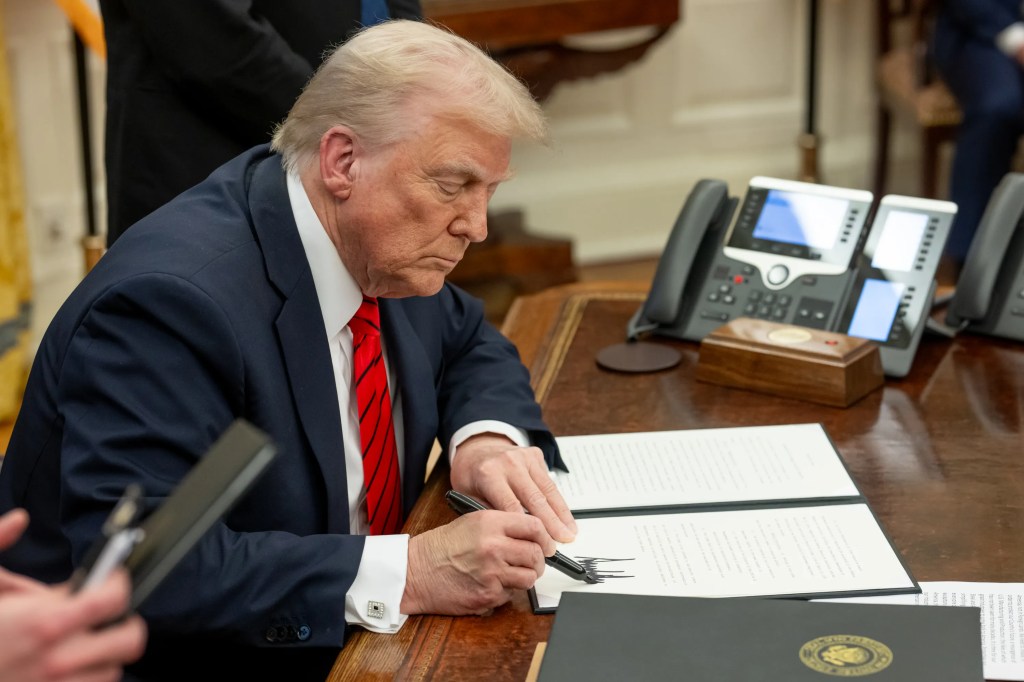
President Donald Trump signed an executive order titled “Improving Education Outcomes by Empowering Parents, States, and Communities” on March 20.
Since then, the President’s office has worked tirelessly to determine how this could potentially affect Missouri Valley College.
College President Dr. Joseph Parisi is continuing to fight for the rights of students and ensure stability across campus.
“I serve on multiple organizations, NAICU, ICUM and I chair the Heart of America Council of Presidents right now,” he said. “What I can say is I stay in tune with the legislation. I will be monitoring very closely any changes or updates so that I can put Missouri Valley College’s best foot forward.”
The National Association of Independent Colleges (NAICU) represents private higher education at the government level.
He also emphasized that he meets with all of the private college presidents in the state of Missouri, and they are in tune with what is happening.
“The Department of Education has been really good to Missouri Valley. We have a lot of confidence and faith in the DOE and what they’re doing,” he said. “They provide grants for us that have transformational changes in people’s lives and educational outcomes. I’m going to continue to lobby for not only students but for private college students to have access to funding sources.”
Section 1 of the Executive Order states:
“ Our Nation’s bright future relies on empowered families, engaged communities, and excellent educational opportunities for every child. Unfortunately, the experiment of controlling American education through Federal programs and dollars — and the unaccountable bureaucracy those programs and dollars support — has plainly failed our children, our teachers, and our families.” Emphasizing the need for state control.
Vice President of Academic Affairs, Dr. Cynthia Bice, is well-versed in the recent changes.
“This isn’t the first time we haven’t had a Department of Education, so it’s not life-shattering in that way,” she said. “What the DOE had oversight for is being reallocated to other departments. From my understanding, student loans and grants, etc., are not going away.”
She also understands that a lot of the control will go back to the state legislature.
“It is going back to the states as it was before, so from my perspective, that just means that we have to be more in tune with our Missouri legislatures and be very proactive in how we educate ourselves and keep ourselves informed,” she said
Bice acknowledged the pros and cons of the dismantling of the DOE.
“There are pros and cons to it, I’m all for giving more control back to the local,” she said. “But the execution of it, as far as the transition of it, is just kind of a wait and see. Every day, I’m getting updates on the current impact.”
Some departments that, as of now, are still going to be under federal control are the Special Education and Nutrition programs are moving to the Department of Health and Human Services and Student Loans are moving to the Small Business Administration.
Bice encourages students to keep themselves informed and look at government websites and resources to learn more about the changes going on at the government level.
The idea of the Department of Education began in the 1860s under President Andrew Johnson. However, people were worried that it would cause too much federal control, so it was demoted to just an office of education. The actual Department of Education didn’t go into effect until the 1980s.
If you would like to learn more about the order, click here.
If you would like to learn more about what the Department of Education does, click here.

 The Delta
Leave a comment