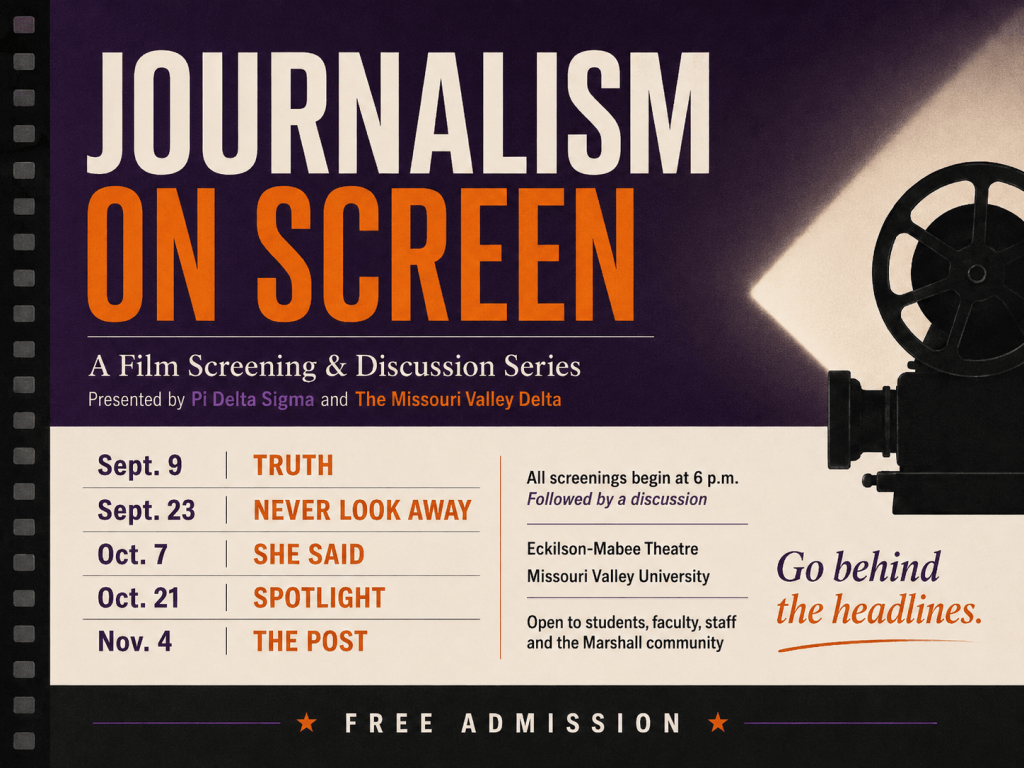
A new film series at Missouri Valley University will give students and members of the Marshall community a chance to look behind the headlines and examine how journalism is actually done.
Pi Delta Sigma and The Missouri Valley Delta will host five film screenings this fall in the Eckilson-Mabee Theatre. Each event will begin at 6 p.m. and will be followed by a discussion about the film, journalism and media literacy.
The series begins Sept. 9 with Truth, followed by Never Look Away on Sept. 23, She Said on Oct. 7, Spotlight on Oct. 21 and The Post on Nov. 4.
The screenings build on a program that has been offered to journalism students for several years, but this semester the events are being expanded to include faculty, staff and members of the Marshall community.
“For several years, we’ve been hosting journalism film screenings as a way to show students what journalists actually do,” said Chris Post, editor-in-chief of The Missouri Valley Delta and advisor for Pi Delta Sigma. “We decided to expand that program this year.”
Post said the goal is not simply to promote journalism, but to help participants better understand how media is produced and how to evaluate what they consume.
“We live in a media-saturated world,” he said. “For better or worse, media content is everywhere, and those who can identify quality content from misinformation or disinformation will be able to make informed decisions and avoid being misled.”
Post said declining trust in the news media is often shaped by the way people encounter news today.
“A lot of great journalism is being done, but the general public doesn’t see enough of it,” he said. “So many people these days get their news from social media sound bites or biased cable network commentators.”
He said that can leave people with an incomplete picture of how journalism works.
“A lot of times people think of a journalist and what comes to mind is a person in a clean suit sitting behind a desk reading the news,” Post said. “They only know the presentation, not the preparation.”
The films selected for the series were chosen to show that preparation.
Four of the five are Hollywood productions based on real events. Never Look Away is a documentary about war photographer and video journalist Margaret Moth.
Post said the films show journalists working long hours, pursuing reluctant sources, challenging powerful institutions and sometimes putting their reputations or safety at risk.
“Facts are checked, double-checked and then checked again,” he said. “Reluctant sources must be convinced of the importance of their testimony.”
The series also does not shy away from journalism’s failures.
The opening film, Truth, focuses on CBS News’ controversial reporting about President George W. Bush’s service in the Texas Air National Guard. Questions about the reliability of documents used in the report ultimately led to major consequences for producer Mary Mapes and anchor Dan Rather.
“That film shows the consequences of when journalists get the story wrong,” Post said.
That willingness to examine journalism critically is an important part of media literacy, he said.
Post often tells journalism students to “trust, but verify” when evaluating sources. He said the same principle applies to anyone consuming news.
“Part of teaching media literacy is getting people to realize that all media should be looked at critically, even news from reliable sources,” he said.
The second film, Never Look Away, presents a different kind of examination.
The documentary tells the story of Moth, a CNN photojournalist known for covering conflicts around the world.
“Her life was messy and she was rough around the edges,” Post said. “But she was also a fearless video journalist who risked her life to bring people the facts.”
Together, Post said, the films help show that journalists are neither heroes nor villains, but people doing difficult work.
“I often say that part of the job of a journalist is to hold up a mirror so readers can see their society as it really is,” he said. “From time to time it’s good for journalists to look into the mirror as well.”
Each screening will be followed by a discussion that begins with the events depicted in the film but will not be limited to them.
Post said he hopes participants will bring their own questions, criticisms and experiences with the media into the conversation.
He particularly hopes people who are skeptical of journalism will attend.
“So many people have this concept of ‘The Media’ like it is some monolithic entity out to do the bidding of some sinister cabal,” Post said. “The reality is the media is made up of thousands of journalists working day and night to find facts and bring them to the people.”
Previous screenings have already shown him how much perceptions can change when viewers see that process.
“I’ve had students who attended previous screenings tell me afterward that they had no idea what journalists go through,” Post said.
That, he said, is ultimately what he hopes the expanded series accomplishes.
“They don’t know the literal blood, sweat and tears that go into producing that news,” Post said. “My hope is that by getting to go behind the scenes, participants will better understand the process and better appreciate the outcome.”


Leave a Reply