By Chris Post / Editor-In-Chief
The century-old auditorium at Bueker Middle School could see new life as a larger community performing arts center under a proposal presented to the Marshall Board of Education.
Kevin Lines, director of the Marshall Philharmonic Orchestra, asked board members during their September meeting to consider preserving and renovating the Harold L. Lickey Auditorium, arguing that the facility remains one of the district’s most valuable cultural spaces despite the age and condition of the building around it.
The auditorium opened in 1923 as part of what is now Bueker Middle School. Lines said the space originally served double duty as both an auditorium and gymnasium, with basketball games and concerts held in the same room.
He said evidence of that early use can still be seen in the auditorium, including holes in the wall where basketball goals were once mounted.
Lines told the board the facility has something that would be difficult to reproduce in a new building: its acoustics.
He recalled performances by the Kansas City Symphony Orchestra in Marshall in 2003 and again 10 years later. Lines said musicians who had performed in the auditorium previously were pleased to return because of the quality of the room’s sound.
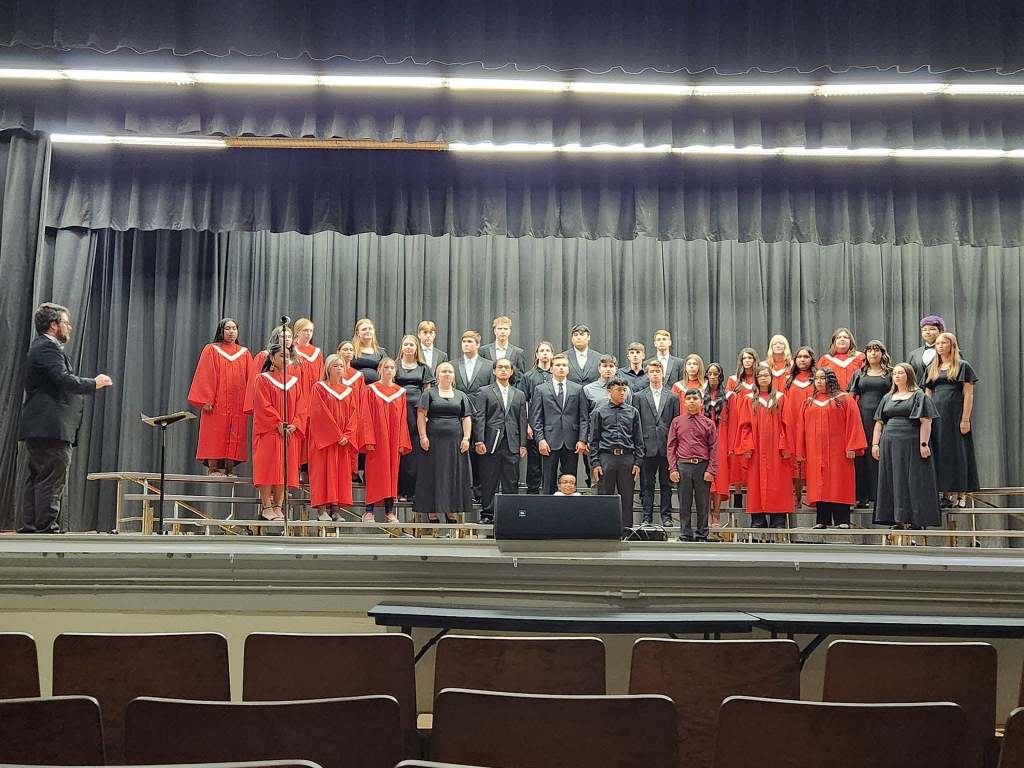
The auditorium continues to serve both school and community music programs. Marshall Public Schools regularly uses the Harold L. Lickey Auditorium for orchestra concerts, and it is also home to performances by the Marshall Philharmonic Orchestra.
Lines, who also conducts the Marshall Philharmonic Orchestra, outlined a series of improvements he believes could transform the space into a more functional performing arts center.
Those improvements would begin with the building itself.
Lines said the flat roof needs to be addressed to eliminate recurring leaks. Electrical service would have to be upgraded to meet the needs of professional productions, while restrooms would need renovation and expansion.
Safety improvements would include replacing or repairing the auditorium floor, replacing seating, installing new concrete stairs and handrails leading to the stage and adding handrails in the balcony.
Lines also said the district would need to find a better way to make the building accessible to people with limited mobility.
“How do we get them into the building in an effective way and in a way that respects them?” Lines asked during the presentation.
The proposal goes well beyond repairing what already exists.
Lines suggested removing classrooms and other spaces behind the stage to extend it approximately 12 feet farther back. Removing the large wooden partitions along the sides of the auditorium could add another 20 to 24 feet of stage width.
That additional space, he said, could make the auditorium large enough to accommodate professional groups that currently cannot perform there.
Lines recalled previously discussing a possible Marshall performance with the United States Air Force Band. The group ultimately determined the existing stage was too small.
Expanding the stage, he said, could change that.
Other proposed changes include creating dressing rooms and storage areas, adding modern stage curtains and developing a dedicated sound, lighting and video control booth.
Lines also proposed removing the existing middle school library and an adjoining classroom to create a larger lobby or foyer outside the auditorium. The space could be used for receptions, art shows and gatherings before performances.
The renovation could also solve another longstanding problem: getting large instruments and equipment onto the stage.
Lines said that when the Kansas City Symphony performed in Marshall, crews had to back a truck up to the building, remove a center post from the entrance and use ramps to move equipment inside.
A redesigned facility could include better backstage access.
Heating and cooling would present another challenge.
The existing system can take several days to switch between heating and air conditioning, Lines said, making it difficult to respond to Missouri weather or meet temperature requirements imposed by professional performers.
He recalled one Kansas City Symphony performance when organizers were warned during intermission that the temperature was approaching the orchestra’s maximum allowable level.
With no immediate control over the HVAC system, organizers opened windows to keep the concert going.
Lines acknowledged that renovating a building more than 100 years old would not be simple or inexpensive. Maintenance, insurance, building-code requirements and unexpected problems discovered during construction could all add to the cost.
Funding quickly became part of the board’s discussion.
Board members said community support would likely be necessary before the district moved ahead with a project of that scale. One member asked whether an organization already existed to begin fundraising for the auditorium.
Lines said he was not aware of one but would like to see such an effort begin.
He also suggested the project might be completed in phases rather than all at once.
The auditorium discussion comes as the district faces a much larger decision about the future of Bueker Middle School itself.
During the same meeting, district officials discussed preliminary estimates suggesting a comprehensive renovation of the existing Bueker building could cost between $24 million and $32 million. Officials have said the district eventually must determine whether to make a major investment in the existing building or pursue another option.
That uncertainty could complicate any effort to renovate the auditorium, but Lines argued the auditorium should not automatically be lost if the district eventually moves students elsewhere.
He pointed to older performing arts facilities that remain in use and said the age of the building alone should not determine its future.
“Could a new auditorium be built? Absolutely,” Lines said. “Could this auditorium be replaced? No.”
For Lines, the question facing the district is not simply whether the Harold L. Lickey Auditorium needs work.
It is whether a space that has hosted generations of Marshall musicians is worth carrying into the next century.


Leave a Reply