By Bradley Radu / Staff Writer
Nearly $800,000 in voter-approved sales tax revenue has accumulated while the Marshall Public Library waited to answer a multimillion-dollar question: Could it safely spend the money?
For much of the past year, the answer from library officials was no.
A legal dispute over Saline County’s classification created enough uncertainty surrounding the quarter-cent sales tax approved by Marshall voters in 2024 that the library halted plans to borrow roughly $3 million to renovate its future home on East Morgan Street.
Library Director Matt Rahner said officials believed the tax was valid, but that belief alone was not enough to justify taking on millions of dollars in debt.
“We were exercising caution because we didn’t want to take out $3 million in bonds and then not be able to pay those back over 15 years,” Rahner said.
That caution left the library collecting the tax while major work on the project remained frozen.
“I think it’s close to $800,000 now from the sales tax that we’ve collected,” Rahner said. “We just haven’t spent any of it.”
That freeze is now ending.
Following a stipulated judgment issued Sept. 21 in a lawsuit involving Saline County Assessor Jessica Goodman and the Saline County Commission, the Marshall Public Library announced Sept. 29 that it would move forward with its renovation and relocation plans.
For Rahner, the significance of that resolution is straightforward.
“We can move forward because that’s no longer a question,” he said.
A legal question with financial consequences
The issue facing the library centered on Saline County’s classification under Missouri law.
The Marshall Public Library’s authority to ask voters to approve the sales tax was tied to statutory language involving county classification and population.
When Proposition L was approved in November 2024, Saline County was treated as a fourth-class county.
The lawsuit raised the possibility that the county should have been reclassified earlier.
For the library, that was more than a technical legal argument. If Saline County had ultimately been determined not to meet the classification requirements when the tax was approved, the decision could have raised questions about the library’s authority to collect the money.
The library could continue collecting the tax while the issue was litigated, but officials were unwilling to build an entire financing plan around revenue that remained under a legal cloud.
Rahner said the worst-case scenario would have been borrowing millions of dollars, beginning construction and then losing the revenue expected to repay the debt.
“If we took out $3 million and we started this project, and then it came back that we can’t collect a sales tax, we have no way to pay that money back,” Rahner said.
The potential consequences made waiting the safer option.
“The collateral is the library,” Rahner said. “There was just too much risk involved.”
That concern explains why the project stopped even though the tax had passed and the money continued to accumulate.
Project halted just before major decision
The legal uncertainty emerged after the library had already moved well into the planning process.
Rahner said officials were preparing to select a construction manager at risk, commonly known as a CMAR.
The construction method allows a manager to participate in the project before construction begins and establish a guaranteed maximum price for the work.
The library had already solicited five proposals and narrowed the field.
“We were about to pick a firm,” Rahner said.
Then the library received a call from its bond attorney.
Rahner said the advice was clear: Stop.
The library suspended the process rather than enter into agreements that could eventually depend on uncertain tax revenue.
Now, library officials are preparing to resume that work.
The library will reengage with Sapp Design Associates, the Springfield architectural firm working on the project, and restart the process of selecting a construction manager.
Rahner estimated it could take approximately three months before the library is ready for significant work at the East Morgan Street building.
Construction could take another six to eight months, followed by additional time to move the collection, equipment and operations.
That puts the project roughly a year away under a favorable timeline, although Rahner said he is hesitant to promise residents a specific date.
“I don’t want to put a deadline on it right now,” he said.
He said the library board plans to release updates as the project advances.
Rahner said the end of 2027 is a reasonable expectation if the project does not encounter additional complications.
The delay has already pushed the project far beyond its original schedule.
“We were supposed to be in there by now,” Rahner said.
He said earlier plans anticipated the library would occupy the new facility by the end of 2025.
Voters approved more than a renovation
Marshall voters approved Proposition L in November 2024, establishing a quarter-cent sales tax with a 15-year sunset provision.
The tax is expected to remain in effect through 2039. Continuing it beyond that period would require another vote.
Although renovating the East Morgan Street property is the largest visible use of the money, Rahner said the tax was designed to support more than construction.
Additional revenue is expected to allow the library to increase programming, potentially add staff and expand operating hours.
The library may be able to remain open later during the week and offer additional weekend hours, although those decisions have not been finalized.
The new building is also intended to solve problems that have shaped library operations for decades.
A temporary space that lasted 36 years
The Marshall Public Library has operated from its current basement location since around 1990.
Rahner said the location was never supposed to become the library’s permanent home.
“They’re like, ‘Well, we’ll just put it here for now, and then we’ll figure something out,’” Rahner said. “Well, fast forward 36 years and we’re still here.”
That history helps explain why library officials view the East Morgan Street project as more than a cosmetic upgrade.
The existing facility has no dedicated study rooms. Its community room is located deep inside the library, making after-hours use difficult. Staff space is limited, and the library has one restroom shared by employees and patrons.
Rahner said the new building is not dramatically larger than the current library.
“It’s not actually that much bigger,” he said.
The difference is in how the space is designed.
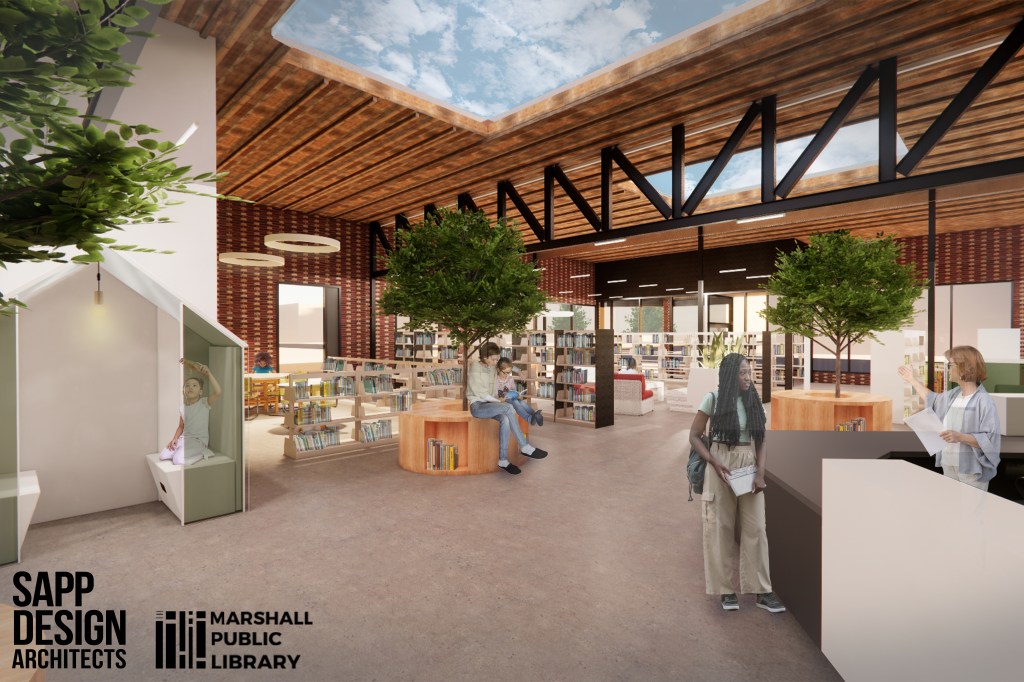
Architectural renderings prepared for the project depict a substantially different environment from the library’s current basement setting, including large windows, open shelving, dedicated children’s areas and flexible seating throughout the facility.
An exterior rendering shows a prominent street-level public entrance rather than a below-ground entrance, while another depicts an outdoor gathering area adjacent to the building.
For Rahner, visibility itself is part of the improvement.
“We’re hard to find,” he said. “It’s in the basement.”
Space designed around modern library use
The new facility is planned to include three study rooms, a community room that can be used after normal library hours and a boardroom that could also be available to local organizations.
The community room is expected to include presentation technology and a kitchenette.
Plans also include additional staff offices and separate restrooms.
A new addition is expected to house the children’s area.
Rahner said the children’s section is also planned to include a quiet room for children who may become overstimulated and for nursing mothers.
The library is also considering dedicated space for computers, 3D printing and other technology services.
Rather than describing those additions simply as amenities, Rahner connected them to what he sees as the broader purpose of the project.
“It’s just going to allow us to do more as a library,” he said. “More services, more staff, more everything.”
That expansion in function is also what supporters say will determine whether the project ultimately matters to residents.
Tonya Eddy, an associate professor at Missouri Valley University and a library supporter, said the library must evolve alongside the people who use it.
“A library must be able to change with the times as the needs of the community change,” Eddy said.
For Eddy, the value of the project is not simply that the library will be newer.
“The library is a location for people to gather and for learning,” she said. “It needs to be a place where people WANT to come to do those things.”
That idea is already reflected in how the library has expanded its programming.
Eddy pointed to activities for adults, children and teens, along with community puzzles, book club kits, art programming and a recently launched mahjong group.
The question now is whether a facility designed around those uses will allow that programming to grow.
“The planned new spaces should allow community members to have a pleasant area to read, work on the computer, or participate in these new programs and socialize,” Eddy said.
Her response also addresses residents who may still think of a public library primarily as a place to check out books.
“Come see what is going on at your library,” Eddy said.
From money on hold to construction
The Sept. 21 judgment did not complete the project.
Instead, it removed the issue that had prevented library officials from being comfortable taking the next financial step.
The library still must restart its construction manager selection process, finalize project details and complete the renovation before the first patrons walk through the new doors.
But after months of accumulating revenue without committing it to construction, the project has shifted from waiting to planning.
The library’s Sept. 29 announcement was brief, stating that it would move forward with the renovation and relocation and provide periodic updates as project details are determined.
Rahner’s description of what comes next was broader.
After more than three decades in a basement originally meant to be temporary, he said the East Morgan Street project gives the Marshall Public Library an opportunity to become more visible and offer services its current building cannot easily accommodate.


Leave a Reply