By Chris Post / Editor-in-Chief
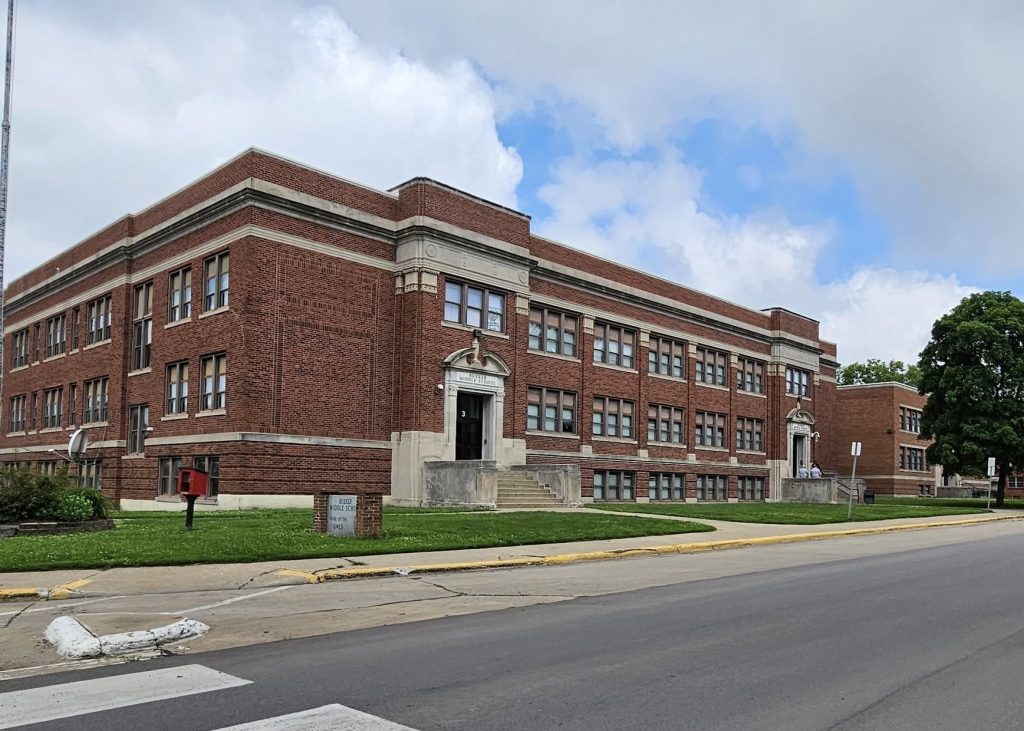
Two proposals to replace Bueker Middle School are emerging as favorites among respondents to a Marshall Public Schools survey, but disagreement over the future of the historic building could complicate efforts to secure voter approval for a property tax increase.
Superintendent Caleb Petet told the Marshall Board of Education that two proposals, both involving construction of a new middle school on the district’s Northeast Campus, were separated by approximately 12 responses as of Tuesday evening.
The difference between the proposals is what happens to the existing Bueker building.
One option would construct a new middle school and leave the future of Bueker to be determined later. The other would include restoration of the historic auditorium and portions of the original building as part of a larger construction project.
Both would require voter approval of a property tax increase.
Petet said the district had received 312 survey responses as of 5 p.m. Tuesday, approximately half from district employees and half from community members.
The results remain preliminary, and Petet cautioned that additional responses could substantially change the outcome.
The survey follows a facility evaluation by Denovo that identified approximately $32 million in necessary repairs and upgrades at Bueker, including electrical work, asbestos removal, roofing, tuckpointing, accessibility improvements and heating and cooling systems.
The district is considering five options ranging from continuing to operate Bueker with repairs made as funding permits to constructing a new high school and converting the existing high school into a middle school.
However, Petet said two options have emerged as clear favorites.
The first, labeled the “Family Minivan,” would construct a new middle school on the Northeast Campus, where Spainhower Primary School and Marshall Intermediate School are located. The future of Bueker would be decided separately.
That proposal carries an estimated property tax levy increase of approximately 78.5 cents per $100 of assessed valuation.
The second proposal, dubbed the “Cadillac,” would also construct a new middle school but include restoration of Bueker’s historic auditorium and part of the original building for use as a performing arts center.
Its estimated levy increase would be approximately $1.18 per $100 of assessed valuation.
Petet said both proposals have alternated as the leading choice among respondents, with neither establishing a substantial advantage.
The uncertainty surrounding Bueker’s future appears to be a significant concern for residents considering the less expensive proposal.
Under that option, the district would move students into the new middle school after approximately two years of construction, but no final decision would have been made about the existing building.
Petet said residents have expressed concerns that Bueker could be left vacant and deteriorating if the district does not establish a plan for the property.
He suggested that the board consider forming a citizens advisory committee to explore alternatives, including restoring the historic portion of the building or eventually demolishing it.
Petet emphasized that he was not making a formal recommendation but discussing possible ways to address concerns raised through the survey.
Some board members also discussed the possibility of involving the city in determining the building’s future.
The challenge, Petet acknowledged, is that community opinion appears sharply divided.
Some residents have told district officials they oppose spending additional money on Bueker, while others have indicated they would oppose any proposal that fails to preserve the historic structure.
Petet warned that disagreement over the building’s future could prevent the district from moving forward with improvements.
“My number one greatest concern,” he said, “is that we can’t get anything done because those who support something become divided over what thing we choose to move forward with.”
The superintendent also raised safety concerns about continuing to operate the existing middle school.
He cited previous incidents involving traffic near the school, including a teacher being struck by a vehicle in a crosswalk and another vehicle reportedly traveling more than 100 mph near school crossings.
Petet said those incidents illustrate concerns about the school’s location that extend beyond the condition of the building itself.
The district’s survey asks respondents to evaluate five alternatives.
In addition to the two leading proposals, residents can support continuing operations without a bond issue, renovating Bueker or constructing a new high school and converting Marshall High School into a middle school.
The renovation proposal would require approximately 600 students to relocate for as long as two school years while work is completed. The survey lists an estimated levy increase of $0.0454 for that option.
The most expensive proposal, construction of a new high school and conversion of the existing high school, carries an estimated levy increase of approximately $2.13.
The survey also asks residents to identify priorities such as student safety, taxpayer costs, historic preservation, fine arts facilities, accessibility and future expansion.
Although the preliminary responses offer some indication of community preferences, they do not represent a scientific sampling of Marshall voters. District employees account for approximately half of the responses collected so far.
Petet encouraged additional participation before the district begins narrowing its options.
The district will hold another community forum Nov. 19 at 6:30 p.m. in Bueker Middle School Auditorium, the final scheduled forum before administrators potentially recommend a direction to the board.
Petet said he expects to close the survey late Nov. 19 or early Nov. 20 and compile the results for board consideration.
A special board meeting could be held Nov. 30 to review the findings, with representatives from Raymond James and Insight Design potentially available to answer questions. That meeting has not been finalized.
The board could then determine whether public feedback provides enough support to move forward with a proposal that would require voter approval.
No final decision has been made about the future of Bueker or whether a tax proposal will appear on the ballot.


Leave a Reply