By Chris Post / Editor-In-Chief
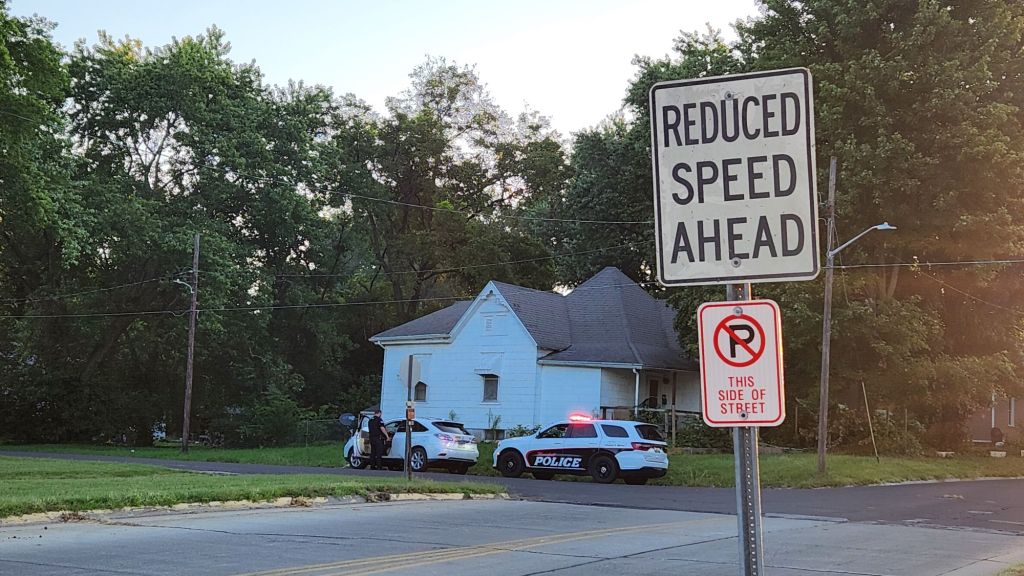
Marshall Police were busy Tuesday morning, enforcing a newly reduced speed limit around the campus of Missouri Valley University.
The speed limit is now 15 mph on designated portions of Morrow Street, Redman Avenue, College Street and Conway Avenue adjacent to the university.
The change took effect immediately and is part of a joint effort involving the Marshall Police Department, the City of Marshall and Missouri Valley University to improve safety around campus.
The reduction comes just weeks after an MVU student suffered critical injuries when he was struck by a vehicle while crossing Morrow Street near Conway Avenue.
Julian Marøy, a member of the Missouri Valley soccer team, was injured Aug. 10 while crossing Morrow Street in a marked crosswalk. A 27-year-old Sedalia woman was later charged with driving while intoxicated resulting in serious injury, second-degree assault and careless and imprudent driving involving an accident.
The collision renewed concerns about pedestrian safety around the university, particularly along Morrow Street, which separates Burns Athletic Complex from the football stadium.
Although the street runs through Marshall, Morrow Street is also Missouri State Route WW and is largely under the control of the Missouri Department of Transportation.
Previously, Marshall City Administrator J.D. Kehrman said city and university officials had been trying for years to get improvements made to the pedestrian crossings along Morrow Street.
“MoDOT is well aware, and there is a real resurgence of local interest following this tragedy,” Kehrman said at the time.
Kehrman said his office had been communicating with MoDOT about the crossings since 2022 after university officials had already spent years seeking changes.
Among the improvements being sought are signs with flashing lights near the two Morrow Street crosswalks. Kehrman said Marshall Police Chief Mike Donnell, Municipal Services Director Randy Cornine and others had also joined efforts to push for changes following the Aug. 10 collision.
Saline County Prosecutor Tim Thompson also organized a task force involving representatives from the city, university and the office of state Sen. Curtis Gregory to examine pedestrian safety around the campus.
At the time, Kehrman said the city was preparing to lower the speed limit on College Street, which is under municipal control, to 15 mph and improve crosswalk signage there. He said the city hoped improvements on College Street could help place additional pressure on MoDOT to make similar changes on Morrow Street.
The newly announced reduction goes farther, establishing a 15 mph limit on designated portions of all four streets bordering or connecting to the campus.
New speed limit signs have been installed throughout the affected area.
According to the Marshall Police Department, the reduction is intended to improve safety for students, faculty, staff, visitors and motorists traveling near the university.
“Motorists traveling through the area are asked to remain alert, reduce their speed, and watch carefully for pedestrians crossing streets in and around the campus,” the department said in its announcement.
University officials issued a similar message, urging drivers to watch for people crossing streets around campus.
“Please be alert, slow down, and watch carefully for students, faculty, staff, and visitors crossing campus streets,” the university said.
Reaction to the change on social media, however, has been mixed. While some commenters welcomed the lower speed limit, others questioned whether reducing speeds alone addresses the pedestrian safety problems around campus.
Brian Hickey wrote that he was stopped while driving 23 mph and said he had not been aware the speed limit had changed. He questioned why motorists can travel faster near Marshall’s middle and high schools and argued that improved pedestrian signals would do more to protect people crossing the street.
“It’s a shame you can drive faster in front of a school with younger kids instead of implementing a better cross walk signal,” Hickey wrote.
Another commenter, Daniel Overly-McDowell, described the change as feeling like a “knee-jerk reaction” to the Aug. 10 collision and questioned how lowering the speed limit would address a crash in which the driver is accused of being impaired.
Overly-McDowell said he supported efforts to improve safety around the university but argued that lowering the limit should be accompanied by infrastructure improvements.
“Flashing crosswalk signs, better lighting, highly visible crossings, or other pedestrian-safety improvements could directly address the risk,” he wrote.
He also called for a broader discussion of dangerous driving, impaired driving, pedestrian infrastructure and enforcement throughout Marshall.
“A lower number on a sign may be part of the solution, but it shouldn’t be mistaken for the solution,” Overly-McDowell wrote.
The Marshall Police Department said it will be actively enforcing the new 15 mph limit and officers were visible in the area Tuesday morning.
University officials thanked motorists for cooperating with the change, saying the lower speed limit is part of the continuing effort to protect the campus community.
“Thank you for doing your part to keep our Vikings safe,” the university said.


Leave a Reply